Those Who Trespass Against Us

Preorder the book
Those Who Trespass Against Us book cover

Those Who Trespass Against Us

The People Vs Reese On The Radio

I was walking out my front door in Malden, Massachusetts, on the evening of October 22, 2008, dressed for dinner with my girlfriend, when the police drew their guns.

“Get on the ground! Now!”

I dropped to the pavement, hands behind my head, as officers swarmed. Handcuffs bit into my wrists. Neighbors watched from windows.

In that instant, my life as I knew it ended. I was no longer Reese Hopkins, the radio host who had spent years telling hard truths on the air. I was a fugitive, accused of raping a twelve-year-old girl in a New York City apartment four years earlier.

The accusation was a lie. And that lie would cost me two and a half years behind bars, my career, my reputation, and nearly everything I had built. This is the story of how falsehoods nearly destroyed me—and how truth, stubborn and relentless, fought its way back into the light.

I had not lived in New York City since March 2004. That spring, the Star & Buc Wild morning show, where I served as news director and on-air personality, had moved its broadcast base to Clear Channel’s WPHH Power 104.1 in the Hartford area. Every week from Monday to Friday 6 a.m. to 10 a.m., I was in the Connecticut studio, delivering the news and commentary that defined my voice.

My family—my then girlfriend and our son—had relocated with me to Manchester. On August 25, 2004, my son started at Verplanck Public School there. We had leases, utility bills, bank records, school enrollment papers. The life we were living was documented, ordinary, and a hundred miles from Manhattan.

The apartment on the Upper East Side that prosecutors would later claim was the scene of a violent rape? It sat empty. A later sworn letter put us out by June 30, 2004—vacant, bare, painted for sale. I had moved on. The show had moved on. Life had moved on.

Until April 2008, when a young woman—a former friend of my girlfriend’s daughter—told her mother a story during an argument over failing grades. That story traveled to the Manhattan Special Victims Squad.

By the time it reached a grand jury, it had become a nightmare: I had allegedly raped her in my bedroom while my stepchildren were nearby, ripped off her clothes, penetrated her, told her to “keep screaming, it’s hot,” kept her clothes so she had to wear my stepdaughter’s, and then assaulted my own stepdaughter. She was twelve at the time of the supposed attack. She was fifteen and a half when she reported it.

I learned of the charges the same way the rest of the world did—through the media and then through the cold steel of handcuffs on my own driveway.

The firing came first. On October 16, 2008, WRKO in Boston let me go amid company-wide cuts. Six days later, the arrest. I was held without reasonable bail—$100,000 cash or $300,000 bond—and shipped to Rikers Island. For two and a half years I lived in a cage while the lie breathed and grew.

Through those years I held to one fact: I had not lived in that New York apartment when the first charge said I did. Connecticut leases, school papers, and an empty Upper East Side unit were the truth. I would not let the lie stand.

I began fighting back in public. I reached out to CNN’s Brooke Baldwin for an interview. Sitting across from her, I laid out the facts: the move to Connecticut in April 2004, the radio schedule that kept me in Hartford studios every weekday morning, the family life in Manchester, the empty apartment in New York. The segment aired. And something shifted.

The evidence I presented on national television—the documentation that my former apartment was vacant and under renovation—became part of the defense file. It was the crack in the prosecution’s case.

The charging calendar did not hold against the out-of-state paper trail. I would go to trial.

The trial began in March 2011 in Manhattan. Jury selection was the least contentious part. What followed exposed the lie in real time.

The accuser took the stand and told a different story than the one she had given Detective Robert Arbuiso in April 2008. Gone were the ripped clothes, the screaming, the blood on the bed, the command to “keep screaming, it’s hot,” the stolen garments. In their place were softer, vaguer details.

She had not screamed. She had not bled. She had not said those things. The violent narrative that had justified my years in jail simply evaporated under oath.

Prosecutors quietly removed Detective Arbuiso from their witness list. He became mine. The man who had taken her original statement testified for the defense, his presence a quiet indictment of the case built on that statement.

After two weeks of testimony and two days of deliberation, the jury could not reach a verdict. A mistrial was declared on March 24, 2011.

One juror later wrote to me. “I think the State has/had a lousy case,” the email said, “and I can’t believe that they are thinking of bringing this case to trial again.”

I was released on April 6, 2011, after bail was reduced to $20,000. Prosecutors spoke of a retrial. It never happened. The accuser was later arrested on an unrelated gun charge, and the case quietly died. No retrial. Just silence where once there had been thunder.

I understand evil now in ways I never wanted to. It does not always wear a mask and carry a weapon. Sometimes it arrives as a story told in anger or confusion, repeated until it hardens into fact.

Sometimes it is enabled by institutions that move too quickly and ask too few questions. Sometimes it is the quiet erosion of a man’s name while he sits in a cell, unable to defend himself on the airwaves that once gave him purpose.

Lies destroy lives the way termites destroy houses—slowly, from the inside, until the structure collapses. They took my freedom, my income, my daily connection to listeners who trusted my voice. They forced my family to endure visits through plexiglass and nights wondering if I would ever come home.

But truth is patient. It gathers documents—leases, school records, utility bills, property management statements—and it waits. It gathers witnesses—detectives who tell what they heard, jurors who see through the fog. It gathers courage in the form of a man who insists on a trial and refuses to let a lie rewrite the record.

I am back on the radio now, hosting Reese On The Radio afternoons on WTIC in Hartford, the same market where I was working when this began.

I speak every day to an audience that knows my voice and, more importantly, knows the truth. The people who trespassed against me with their falsehoods took years from me. They will not take my platform.

Evil must be matched by truth. That is not a slogan. It is the lesson I earned in the hardest way possible. Those who bear false witness will answer for it—in courtrooms, in public opinion, or in the quiet judgment of their own conscience. Until then, the rest of us keep speaking.

We keep the record straight. We stay on the air. And we refuse to let the lie have the last word.

What follows is how the lie learned to walk—ink, oath, and a calendar that would not stay still.

7

Ink

The Notebook

The story did not begin in a courtroom.

It began in a notebook.

Most people never see how a criminal case is born. They imagine sirens, a chase, a smoking gun. What they get, more often, is quieter and more dangerous: a room, a detective, a young woman talking, and a hand moving across paper. In Manhattan Special Victims, that paper matters. Special Victims investigates the worst accusations the city hears — crimes against children among them. What goes into those notes does not stay in those notes. It travels. It becomes a complaint. The complaint becomes a warrant. The warrant puts handcuffs on a driveway in Malden. The first indictment follows. Then the years.

Spring 2008. A detective sat with a young woman who had been a friend of my stepdaughter and wrote.

Occurrence: fall of 2004. One complainant. Happened once. A friend’s mother’s boyfriend. An Upper East Side apartment.

8

By then, the paper trail of my actual life said something else entirely. Keys returned. Rooms vacant and bare. A Connecticut lease. Morning radio in Hartford. A child enrolled in school in Manchester. I had not lived in that New York apartment since March 2004. The notebook did not pause to reconcile any of that. Notebooks rarely do. They take a story down. The system treats the story as a starting gun.

I was not in that room. I did not hear the first telling. I did not get to ask a question while the words were still soft enough to correct — while a date could still be questioned, while a detail could still be walked back, while someone might still say, wait, that doesn’t fit. Once ink dries in a Special Victims file, it acquires a kind of gravity. Prosecutors will build on it. Judges will hear it described as if it were a photograph. Listeners to the news will receive a version of you that was written before you knew you were being rewritten.

9

That is the part that is hard to explain to anyone who has never been processed by paper. Your life does not end only when the cuffs click. It ends a little earlier, in a handwriting you never saw, on a page you were not invited to read. Someone else narrates you. Someone else places you in a room you had already left. Someone else assigns you a crime that never happened.

From those pages came the complaint. From the complaint, the warrant. From the warrant, the first indictment. From the indictment, the years — Rikers, the cage, the name taken off the air and handed to a charge that never took place.

A detective’s notes can sound like truth if nobody checks them against daylight. An SVS notebook is not a novel. It is an intake — dates, actors, a theory of what occurred. That theory, once filed, does not need your consent to become the official story of your life. Checking the apartment. Checking the pay stubs. Checking whether “fall of 2004” can survive a man who was already living somewhere else — that work comes later, if it comes at all, and often only because the defense forces it into the light.

That spring, a story that started as words in a room became ink. Ink became process. Process became my life.

The accusation was a lie. The notebook was how the lie learned to walk.

10

Under Oath

March 9, 2011 · Manhattan

Cross-examination is not a TV speech. It is a method.

A lawyer takes a prior statement — here, the spring-2008 notes Detective Robert Arbuiso took from the young woman who accused me — and puts those notes between the witness and the story the case has been telling for years. The point is simple and brutal: did you say this? Under oath. With a jury listening. With the notebook’s words no longer floating as rumor, but pinned to a question that requires an answer.

My lawyer put the notebook between her and the truth.

He did not raise his voice. He raised her own alleged words.

What follows is not every question from that afternoon. A full transcript would numb you. What matters is the pattern: the notebook’s violent furniture, offered one piece at a time, and a witness who kept stepping away from it.

11

He began with the room itself — the stage the notes had built.

Q. You told the detective that when you went into the room, there was a towel covering the window, didn’t you?
A. I didn’t say that.

Q. When you spoke to the detective, you told him my son was home.
A. I didn’t tell him that. I said I didn’t know who was in the house.

Then the sound the case had needed — the scream that makes a story feel true to strangers.

Q. You told the detective that you were screaming.
A. I didn’t say that, either. I said I wasn’t screaming. I was not screaming.

On the stand that day she had yelped — a sharp intake of breath, the body doing what the voice denied. In the notebook, according to the questions put to her from those notes, she had been screaming. Screaming for the stepdaughter in a room “right next door.”

Q. You told the detective the stepdaughter was in the room right next door.
A. There’s no room next door to the bedroom, so that’s impossible.

Q. You told the detective you were screaming for the stepdaughter.
A. No, I didn’t say that.

12

For almost three years the public story — and the charging story — had worn a certain costume: force, noise, blood, stolen clothes, a sequel involving my stepdaughter. Those details are how a lie borrows urgency. They are how a notebook becomes a warrant becomes a cage. He did not need to recite the whole catalog three times. After the scream came the blood — “all over the bed,” “so bad” — denied. After the blood came the clothes — stolen, kept, borrowed from the stepdaughter so she could get home — denied. After the clothes came the sequel the notes had carried: after he raped you, he raped the stepdaughter.

A. That was purely an opinion-based statement… not… factual.

One by one, the nightmare that had justified the years came off the truck.

Here is the institutional tell, and it matters as much as any single answer. The People had not called the lead detective — the man who took the April 2008 statement, whose notebook had been the spine of the case. We did. When a prosecution builds a cathedral on intake notes and then declines to put the note-taker on for the People, the defense is left to do what daylight requires: drag the handwriting into the room and ask whether it still stands.

13

I sat there and watched a story that had cost me two and a half years fail its own handwriting.

“I didn’t say that” is not a magic spell. It is a collision — between ink from 2008 and sworn memory in 2011 — and the jury gets to watch the collision in real time.

A case built on a notebook has to survive the notebook under oath. That day, the person those notes were written about kept saying she never said what the notes said she said.

Truth does not always arrive as a speech. Sometimes it arrives as a woman on a witness stand saying, again and again, in different doorways of the same house: I didn’t say that.

14

Who Set the Dates

Dates are doors

Dates are not poetry. Dates are doors.

Open the wrong door and a man is in Connecticut with a pay stub, a lease, and a school enrollment. Open another and he is still inside a New York apartment the paperwork says he had already left — vacant, bare, painted for sale after the keys went back at the end of June 2004. A false accusation does not only need a villain. It needs a calendar that can hold him.

The first grand jury heard September 2004.

My lawyer read it cold — not as argument, as record.

The ADA: Sometime in September of 2004. Do you remember that time?
The accuser: Yes.

15

That “yes” is a door slamming on the wrong side of my life. Fall 2004, in that apartment, is a theory that cannot survive the ordinary documents of ordinary days: a Manchester lease on Downey Drive, Clear Channel work in the Hartford market, a child starting school, an Upper East Side unit no longer ours. If the crime is placed where I no longer lived, the accusation is not merely contested — it is geographically impossible on the paper trail. So the date is not a detail. The date is the load-bearing wall.

Nearly two years later, before a second grand jury, the window moved.

Spring.

Not because the sun changed. Because the paperwork had started to matter. Alibi notices went in. Leases and empty-room proof and pay records stopped being background noise. And the charging theory moved with the calendar — dates, counts, the shape of what the People said I had done. In plain English: when the first map of the case ran into documents it could not ignore, the map was redrawn.

16

On cross in 2011, the question was not only what she told the detective in 2008. It was who built the calendar that made the story fit.

Q. Before the second grand jury, you and the ADA talked about the dates, right?
A. Yes.

Q. She told you there’s no way it happened in September, October of 2004.
A. Right. That was after I had said I don’t think it happened then. I don’t know when it could have happened.

The fall window — the one the first grand jury heard as a clean “yes” — becomes, under oath years later, a window someone else told her could not be right. Then comes the line that belongs in any honest account of how a lie hardens into a case:

A. I wasn’t the one who set up the dates for September or October. That is the time that the district attorneys and the detective, given that I told them stuff, they came up with it, along with my mother… I never said it was for sure… Even in the grand jury, I said I think so.

As she sat there in 2011 — exact date?
A. No. After Great Adventure.

17

So the notebook’s season becomes a negotiation. The first grand jury’s September becomes a soft “I think so.” The later theory reaches for spring. The accusation needed a man still living in that New York apartment in the fall of 2004. The paperwork said otherwise. The witness, under oath, said she was not the architect of the dates that made the architecture work.

I am not asking you to parse every count number. I am asking you to feel the unfairness of a moving target. You build a defense for the door they opened. They open another. You bring leases for the apartment they named. They adjust the season. The public still hears one simple sentence — accused — while the calendar underneath that sentence is being renovated in real time.

Ink wrote me into a room I had already left. Under oath, the ink’s witness spent an afternoon saying she never said the violent parts the notes attributed to her — and that she was not the one who set the dates that made the story fit the rooms.

We keep the record straight.

We refuse to let the lie have the last word.

18

THE EVIDENCE

Contemporaneous clips, then CNN

These are not recollections written after the fact. They are the clips that already existed when the accusation arrived.

February 15, 2004. The Hartford Courant maps the fight for the city’s hip-hop dial: Infinity’s Hot 93.7 against Clear Channel’s new Power 104.1.

May 18, 2004. The New York Daily News sits in on the Power 104.1 morning show and names the cast — Star, Buc Wild, Prozac Girl, Miguel, and “Crossover Negro” Reese.

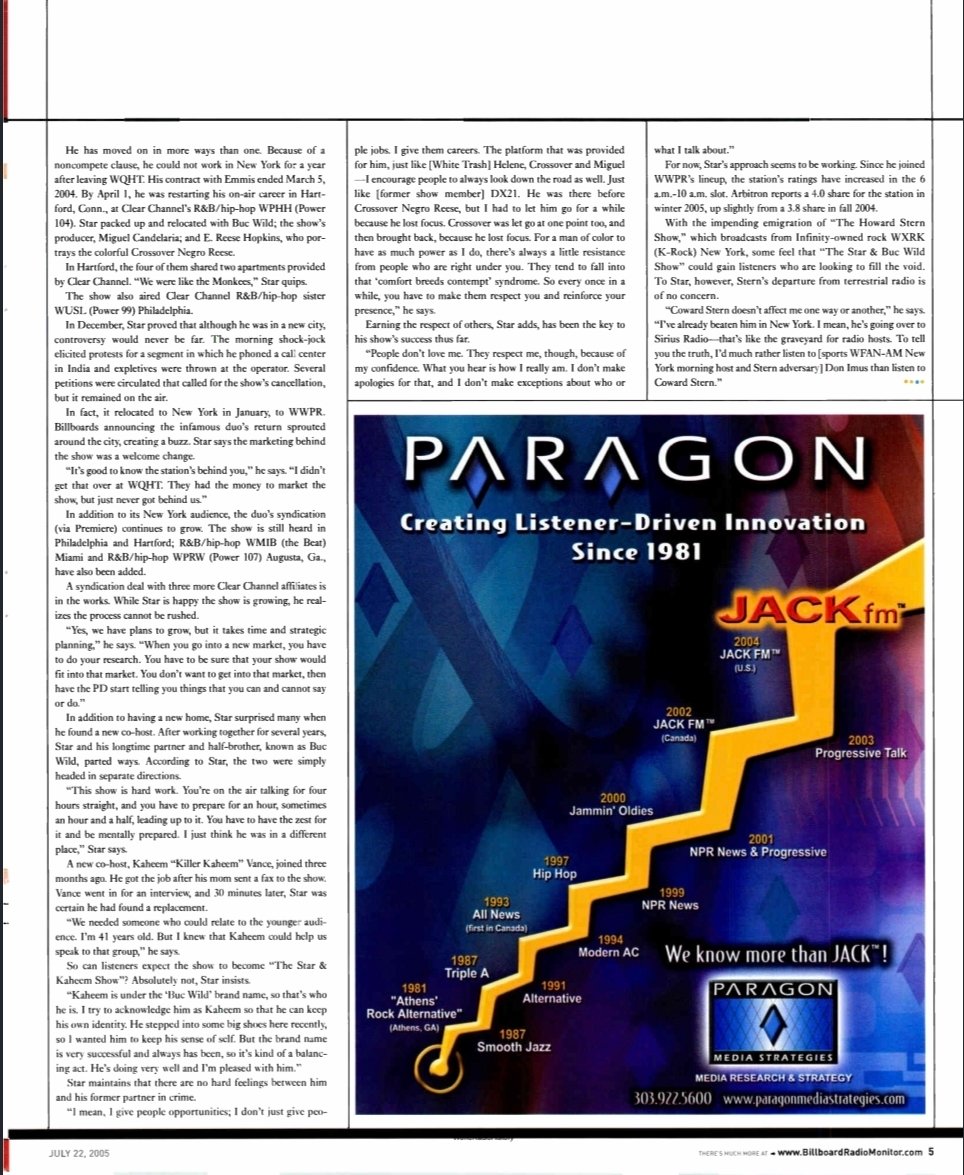
July 22, 2005. Billboard Radio Monitor puts E. Reese Hopkins on the record as a show staple who relocated with the broadcast to Hartford in April 2004.

October 23, 2008. The Boston Herald reports the arrest — and prints the denial given that day: October 1, 2004; Manchester, Connecticut.

March 17, 2010. CNN airs Brooke Baldwin’s jailhouse hour. The landlord letter and the empty-apartment letter are on camera.

19

HARTFORD’S HIP-HOP POWER PLAY

Hartford Courant · February 15, 2004

Who has Hartford on lock?

In the lingo of rap radio, one local station has backed up that claim for more than two years with top ratings. But since September and the emergence of another big player on the dial, the allegiance of the region’s beat-hungry listeners has become an open question.

As they vie for ratings, advertising dollars and essential street credibility, both the reigning champion, WZMX-FM (Hot 93.7), and the challenger, WPHH-FM (Power 104.1), have taken the stance of top dog, strategically ignoring each other except for the occasional on-air jab.

If the names on the local playlists — Chingy, G-Unit, Jagged Edge, Sean Paul, Lil John — sound unfamiliar to some, they probably do not to most teenagers, regardless of their race. It is the proven cultural and economic power of this music that has made it possible for two commercial “urban” stations to co-exist in a market ranked 49th in the nation.

Within one cycle of the ratings that Arbitron releases four times a year, the station had jumped from ninth place into first place among listeners 18 to 34 years old.

“I think it’s one of the great success stories in the format,” said Sean Ross, an expert on hip-hop and R&B radio at Edison Media Research in New Jersey.

The station’s local competitors were certainly watching. After Infinity had run free with Hot 93.7 for more than two years, its biggest competitor, Clear Channel Communications, jumped into the game.

One day the previous September, alternative rock vanished from 104.1 as Clear Channel launched the urban format with 10,000 songs in a row — a sonic incentive for listeners to “flip the power switch” away from Hot 93.7.

Companion Courant reporting from September 17, 2003, dates that flip to 5 p.m. on September 15. WMRQ became Power 104. The summer book had already placed Hot 93.7 first among adults 18–34 with a 21.8 share.

Power 104 is the station that would take the Star & Buc Wild morning show that spring. That is the bridge from this Courant feature to the next documents.

STAR SENDS CLEAR SIGNAL ON AVOIDING EXPLICIT TALK

New York Daily News · May 18, 2004

If there ever seemed to be a radio mismatch, it’s former WQHT morning host Star and Clear Channel, the radio company that has vowed to keep its airwaves free of exactly the kind of explicit talk Star offered regularly on Hot-97.

But now he’s doing mornings on Clear Channel’s WPHH (104.1 FM, Power-104.1) in Hartford, and judging from a recent show, he’s doing what he says he can do: the same show, just staying inside the lines.

On this particular show, he was talking about “men on the down-low,” or closet bisexuals. In the old days, Star would have been explicit. Now there was nothing even close. The focus was how widespread the syndrome might be and what it meant for a man’s heterosexual partners.

With this and other stories, Star made a point of involving the whole team: his partner Buc Wild, Prozac Girl, “Crossover Negro” Reese and Miguel.

Reese got the most exposure in a long discussion about abortion, which he opposes under all circumstances.

Sex was a frequent topic, but the conversation never got more explicit than the semi-code term “carpet-munching” or Star saying his picture is “in the homo section” of a Web site.

“Folks, I’m here to protect the license,” Star said. “There’s too much money at stake now to be jeopardizing the license.”

When Prozac Girl brought up Michael Jackson, Star joked, “Maybe he’ll take himself out.” Reese cracked, “Wouldn’t that be great news?” and quickly added, “I mean, that’d be great media coverage.”

The date on this column is May 18, 2004. The show is in Hartford. Reese is on the air in that studio, named in a New York newspaper, two months after the move the memoir describes.

Behind the Scenes of Star (and Buc Wild)

Billboard Radio Monitor · July 22, 2005 · Ivory M. Jones

For the past five years, Star and his cohort, Buc Wild, have been taking on such industry big shots as BET (“Bamboozled Entertainment Television”), “Coward Stern,” and even their former radio home, Emmis-owned R&B/hip-hop WQHT (Hot 97) New York.

While still on the air at WQHT, Star had no qualms about expressing his feelings regarding the station. He chalks up his no-holds-barred approach to having a high level of confidence.

“I am very confident in myself. That’s what makes me how I am. Some might call it cockiness, but I’m just confident,” he tells Billboard Radio Monitor. “It comes from an early age.”

While at Hot 97, his show rose quickly. Star’s sharp-tongued approach and unique cast of supporting characters (show staples include Crossover Negro Reese and White Trash Helene) helped propel it to the top.

Because of a noncompete clause, he could not work in New York for a year. By April 1, 2004, he was restarting his on-air career in Hartford, Conn., at Clear Channel’s R&B/hip-hop WPHH (Power 104).

Star packed up and relocated with Buc Wild; the show’s producer, Miguel Candelaria; and E. Reese Hopkins, who portrays Crossover Negro Reese.

Clear Channel provided two apartments. The Hartford show also piped into WUSL (Power 99) Philadelphia. From there the morning franchise moved back into New York at WWPR.

Trade paper. Full name. Hartford, April 2004. That is the document.

Billboard Radio Monitor July 22 2005 — Star Power feature naming Reese

Same issue week of July 22, 2005 — Hartford / Power 104 relocation detail, and the supporting cast on the record.

Billboard Radio Monitor July 22 2005 — Hartford relocation and Power 104
Billboard Radio Monitor July 22 2005 — issue page

Ex-WRKO host facing child rape charge

Boston Herald · October 23, 2008

Former WRKO yakker Reese Hopkins, who was laid off last week from his midmorning radio slot, was ordered held without bail today and will be transported to New York City to face charges that he raped a 12-year-old girl, according to the New York district attorney’s office and police.

Hopkins, 39, is charged with one count of first-degree rape and one count of second-degree rape, said Manhattan district attorney spokeswoman Jennifer Kushner. The rape allegedly occurred four years ago.

New York police Detective Martin Speechley said the victim, who was 12 at the time of the alleged rape, was visiting a friend’s apartment in Manhattan when Hopkins allegedly raped her.

Hopkins lived in the apartment with his girlfriend, who was the mother of the girl the alleged victim was visiting, Speechley said. The girl, who is now 16, told her mother about the incident this past summer, and her mother called police. “We only became aware of it this year,” Speechley said.

Julie Kahn, vice-president of Entercom New England, owner of WRKO-AM (680), said in a statement: “We recently learned of the allegations regarding our former employee, Reese Hopkins, and obviously are troubled by them. As the matter is pending in court, however, we will have no further comment.”

Police arrested Hopkins, who lives in Malden, last night. Hopkins, who is listed as Edward Maurice Hopkins on the warrant, denied the fugitive-from-justice warrant charge in Malden District Court. Hopkins is waiving extradition, and his attorney said he is scheduled to return to New York tomorrow.

After court, Hopkins denied the charge as he was being led into a Middlesex County Sheriff’s van.

“She charged me on Oct. 1 of 2004. I was living in Manchester, Conn. I couldn’t have been there,” he said, wearing shackles and appearing shaken and disheveled. “She was a former friend of my daughter.”

When asked how old the friend was, Hopkins said, “I don’t quite remember.”

Hopkins’ girlfriend, who declined to give her name, called the allegations a “vendetta.” “He’s a warm, loving, good-natured person. It’s a false allegation,” said his girlfriend of seven years. She said Hopkins was arrested as the couple headed out to dinner.

That is the Herald story as it ran on October 23, 2008. The charge is printed. So is the denial. So is Manchester, Connecticut. So is October 1, 2004.

CNN: Rick’s List

Jailhouse interview with Brooke Baldwin

Recorded Monday, March 15, 2010, at a Manhattan detention center. Baldwin was allowed one hour. A Department of Corrections official sat in.

The segment aired Wednesday, March 17, 2010, at 4:00 p.m. ET on CNN’s Rick’s List, hosted by Rick Sanchez. Rush transcript. CNN: “This copy may not be in its final form and may be updated.”

What follows is the portion of that segment that puts the landlord letters and the empty-apartment proof on national television — Sanchez’s introduction, Baldwin’s report, and the Hopkins clips about where he was living. Dialogue about charging bargains from that interview is omitted here.

RICK SANCHEZ, CNN ANCHOR: It’s time now for “The Brooke Block,” so named by Brooke. And this is where she brings us a list of the stories that is almost always captivating not just to her, but to many of you. But today she’s doing something a little bit different.

Today we’re looking at a radio talk show host. His name is Edward Hopkins. He’s making headlines.

He’s actually well known nationally for his gift of gab and his political commentary. And you probably are familiar with his one-time syndicated radio show on Hot 97. It was called “Star and Buc Wild.” And his Boston midday show on WRKO.

In fact, I’ve had him on my show in the past, just doing an interview about something. And we had him on as a guest. This was in October of 2008.

But since then, man, his world has been rocked, it has changed dramatically. And the guy that we interviewed back then is not the guy we’re talking to now.

BROOKE BALDWIN, CNN CORRESPONDENT: So, you talked to him in October of ’08. You were talking presidential campaign. Two days later, Reese Hopkins — he goes by “Reese” — he was arrested and charged with raping an 11-year-old girl.

Now, I have been working both sides of this story. We’ve been trying to reach the victim, hear her side, but also hear from Hopkins.

And guess where I was Monday? I was in jail.

I was allowed one hour. I had a Department of Corrections official sitting over my shoulder and watching the clock. One hour with Hopkins and, of course, question number one, did he do it?

(BEGIN VIDEO CLIP)

HOPKINS: I’m begging for somebody to believe me. I don’t think that’s going to happen.

I didn’t rape anybody. I would never rape anybody. It’s an ugly crime, and I am not an ugly person.

I want to go home. I mean, what do I have to do? I thought I did what was asked of me. I wasn’t there.

(END VIDEO CLIP)

BALDWIN: Here is what the other side is saying. The assistant district attorney’s office is speaking on behalf of the victim. She’s still not 18, so they wouldn’t talk to us on camera, but they gave us this statement.

They say, “The grand jury found there was ample evidence to indict the defendant on charges of raping a child. We will decline further comment until this case comes to trial, particularly with respect to the victim, who is still a minor.”

SANCHEZ: When did this rape allegedly happen?

BALDWIN: It happened a couple years ago. It happened some time between September and October of 2004.

But according to the ADA office — they’re the one handling this thing and speaking on behalf of the victim — they say, you know, she didn’t come forward with the accusation until three and a half years later.

A little bit more background. The alleged victim says Hopkins raped her in his Upper East Side Manhattan apartment which he shared with his then-girlfriend and their children. The connection here is that his girlfriend’s daughter was friends with the alleged victim. He said she would come over a couple of times a week, she lived on the same block. But he emphasized to me in our interview — and I tell you, I pressed him on this — he said he was never alone with her and he never acted inappropriately.

SANCHEZ: Well, if you say you don’t do something or haven’t done anything — I mean, he sounded to me like a guy who is really willing to make his defense and say, I did not do this — does he have an alibi? Does he have any kind of proof where he can put himself somewhere other than where they say he was?

BALDWIN: Yes. So I have two pieces of paper. This is essentially his alibi here.

He has these documents. One is from his landlord saying that he absolutely moved out of his Manhattan apartment where this alleged rape occurred and into a Connecticut apartment five months before this alleged rape happened.

I also have a letter from the owner of the condo in Manhattan. Says he was out of there, he handed him the keys, it was empty.

Now, since the alleged victim never actually went to the hospital after this alleged rape happened, there is no DNA, no evidence to prove his guilt or innocence. But Hopkins says it really all boils down to his word versus hers.

(BEGIN VIDEO CLIP)

HOPKINS: I’m going to do everything I can to prove my innocence. But nonetheless, everybody else is going to look at me and they’re going to have that little wondering eye — well, what if he did? And I’ve got nothing to defend that.

But I’ve done everything to defend that. I’ve proved that I wasn’t in New York in September. I’ve proved that I was living out of state. I was living out of state months before.

I’ve done every bit of that. I’ve done what’s been asked of me by law. Prove you weren’t there. And I did that.

BALDWIN: You feel like you’re being totally railroaded?

HOPKINS: I have to be being railroaded. There’s no other way to put it.

(END VIDEO CLIP)

That is where this excerpt ends. The letters were on camera. The calendar was the fight. The rest of the public record is in the Evidence section below.

Excerpt · Those Who Trespass Against Us · 35 pages incl. cover

Those Who Trespass Against Us book cover

Evidence — primary documents

These are contemporaneous records and charging instruments.

News clips below them are secondary.

Primary exhibits

Three anchors first: Hartford pay stub, vacant/bare landlord letter, and the charging-window shift.

Contemporaneous press (primary)

Promoted out of Folder 5 — place-and-time press, not arrest clips.

NY Daily News · May 18, 2004

Star sends clear signal on avoiding explicit talk

Names Reese on the Hartford Power 104.1 morning show — contemporaneous place-and-time press.

Billboard Radio Monitor · July 22, 2005

Behind the Scenes of Star (and Buc Wild) — Ivory M. Jones

Names E. Reese Hopkins; show restarted in Hartford at WPHH Power 104 by April 2004. Open the July 22, 2005 Billboard PDF.

Timeline

Dates only. Paper trail vs. charging frame.

When Your life / paper trail What the charge said
~Mar–Apr 2004 Show / family move toward Hartford market (Billboard: Star & Buc Wild restart WPHH by ~Apr 1, 2004; cast includes E. Reese Hopkins). Memoir: not living in NYC since March 2004.
May 18, 2004 NY Daily News names you on the Hartford Power 104.1 morning show.
Jun 26, 2004 Downey Drive, Manchester, CT lease begins (term through Jun 30, 2005).
Jun 30, 2004 Landlord Lorraine Wohl (sworn): tenants vacated, keys returned; apartment vacant and bare; painted for sale.
Aug 25, 2004 Son starts Verplanck Public School, Manchester (memoir).
~Sep 15, 2004 Wohl: contract to sell apartment ~this date (apartment already empty).
Sep–Oct 2004 Clear Channel / Hartford weekday mornings; living in Manchester on paper. First theory: rape window at 208 East 90th St. (complaint / first indictment frame).
2005 Related child-protective lane: NJ DYFS not substantiated; NY OCFS unfounded (stepdaughter). Letter to ADA: never inappropriate (defense hold).
Jul 22, 2005 Billboard Radio Monitor: relocated with show to Hartford April 2004.
Apr 25, 2008 Accuser speaks to Det. Robert Arbuiso (per defense papers). Occurrence field locks fall 2004 / Oct 1, 2004 style dating at East 90th.
Oct 16, 2008 WRKO layoff (news).
Oct 22–24, 2008 Arrest Malden; warrant; GJ certificate; first indictment 5324/08 — rape + endangering, fall 2004, one primary complainant narrative. Same.
Oct 23, 2008 Boston Herald prints denial: Manchester; couldn’t have been there for Oct 1, 2004 date. Charge as reported in Herald.
Mar 17, 2010 CNN Rick’s List: landlord / empty-apartment letters on camera. Still operating under first charging calendar in public coverage.
Apr / May 2010 Defense alibi notices filed.
Jul 6–mid Jul 2010 People re-present; superseding Ind. 3349/2010 wholly replaces first. Rape window → spring 2004 (Apr–Jun); adds sex-abuse counts as to two children.
Jan 7, 2011 Wiley: finds CPL 190.50 issue on GJ witness request; denies dismissal.
Mar 2011 Trial. Accuser’s cross collides with Arbuiso notes (screaming / blood / clothes / sequel walked back). People do not call lead detective; defense does. Hung jury / mistrial (~Mar 24 per memoir).
~Apr 2–6, 2011 DOC discharge / release on reduced bail (hold + memoir). Retrial talk; public memoir ending: no retrial.

Downey Drive lease term (Jun 26 2004–Jun 30 2005) → keys returned / vacant-bare Jun 30 2004 (Wohl) → Clear Channel stub shows Buckland Hills #7122 by Dec 15 2004. Two CT addresses = sequence, not confusion.

The first charge needed a man still in that New York apartment in fall 2004. The leases and landlord letter put that apartment empty after June 30, 2004. After alibi notices, the official window moved to spring.

Folder 1 — Geography & calendar

Highest priority for a reporter. Contemporaneous place-and-time records. (Hero row above highlights the same anchors.)

Folder 2 — Charging calendar

What the People charged — the moving target. Alibi notices and superseding indictment are paired: why the window moved.

Folder 3 — 2005 DYFS/OCFS

Protective findings for context — not a 2004 verdict. Public labels only; names redacted in the PDFs.

Folder 4 — Trial collisions

Primary trial excerpt first; one-screen table below. Not the full trial volume.

Primary document PDF

Trial cross — March 9, 2011 (stamped exhibit)

Stamped page images from the accuser’s cross (court pp. 185–191, 195–199): walk-backs of 2008 detective notes, screaming/blood/clothes denials, and who set the Sept/Oct dates (“I wasn’t the one who set up the dates… After Great Adventure”). Then-minor names blacked out. Labels: accuser / stepdaughter only.

Notebook claim (as put on cross) Under oath (Mar 9, 2011)
Screaming “I didn’t say that… I was not screaming.”
Blood “all over the bed” Denied / walked back
Stolen / kept clothes Denied
Sequel involving stepdaughter “Purely an opinion-based statement… not… factual.”
Who set Sept/Oct dates “I wasn’t the one who set up the dates… DAs and the detective… along with my mother…”
Exact date “No. After Great Adventure.”

One-screen summary of the same cross. Primary exhibit: 2011-03-09_accuser-cross-STAMPED.pdf. Curated text Q&A (secondary companion only): 2011-03-09_accuser-cross-redacted.pdf. Complete Vol. 3 remains in the defense hold for credentialed reporters on request — not posted here.

Folder 5 — News clips (secondary)

Demoted under primary letters and contemporaneous press above. Arrest clips further demoted. Daily News / Billboard live in the primary press row — not here.

In 2008 the People charged a fall-2004 rape at an Upper East Side apartment the landlord’s sworn letter says was vacant after June 30, 2004. After alibi notices in 2010, a superseding indictment moved the window to spring 2004. At trial in 2011 the primary accuser’s account collided with the lead detective’s 2008 notes; the jury hung; the public record ends in mistrial and no retrial. Reporter one-liner · Evidence pack

Credentialed reporters: request full transcript cites / additional subpoena returns via the contact form on reeseontheradio.com (subject: Evidence / Those Who Trespass).

Excerpt + primary documents · Those Who Trespass Against Us · Reese On The Radio